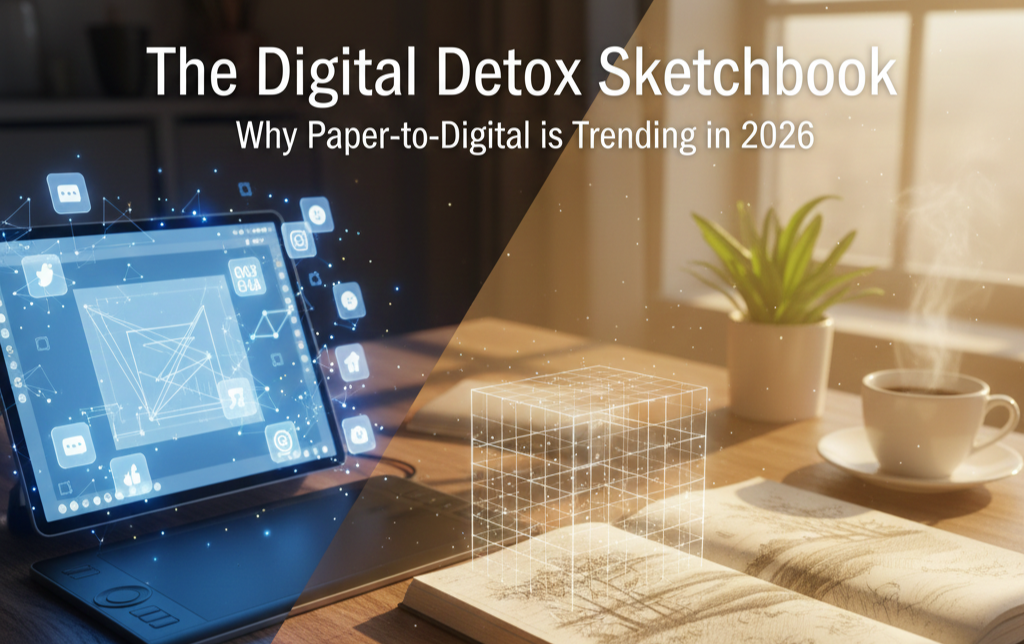
To begin with, we must admit that our world has become very digital. In 2026, we will spend most of our waking hours looking at screens. Whether it is for work, social media, or even entertainment, our eyes are constantly glued to a glowing display. In fact, many people are starting to feel a new kind of “screen fatigue.” This is not just about tired eyes; it is about a mental weight that comes from being always connected.
However, for many of us, there is a simple solution right at our fingertips. Have you ever felt the urge to put down your phone and pick up a real wooden pencil? Surprisingly, more and more artists are doing exactly that. They are rediscovering the joy of a physical sketchbook. This movement is often called a “Digital Detox.” It is a way to find peace and quiet in a loud, high-tech world. Consider these signs that you might need a digital detox:
- ➮ You feel “locked” by the undo button: You find yourself tapping the screen out of habit even when drawing on paper.
- ➮ Constant notifications: You struggle to finish a single sketch because your phone keeps buzzing with updates.
- ➮ Loss of tactile joy: You miss the smell of graphite and the sound of a pen scratching across a page.
- ➮ Artificial lighting strain: Your eyes feel dry and itchy after a long session of digital drawing.
The Magic of the “Analog Start”
Specifically, starting your art on physical paper has many benefits that a screen simply cannot match. There is a special tactile feeling when a pencil moves across a textured page. You can feel the “tooth” of the paper and the pressure of your hand. In addition to being a sensory experience, drawing on paper allows for better focus. Furthermore, a physical sketchbook feels like a safe space.
To illustrate the power of the “Analog Start,” here is why your brain loves paper:
- ➮ Slower Brain Waves: Drawing by hand encourages a meditative state that reduces cortisol and stress levels.
- ➮ Muscle Memory: Physical drawing builds a stronger connection between your hand and your eye than a slippery glass screen.
- ➮ No Charging Required: You can take your sketchbook to a park, a cafe, or a mountain top without worrying about battery life.
- ➮ Permanent Progress: You cannot accidentally delete a physical page; every stroke is a permanent part of your history.
Why We Often Quit (The Bridge Problem)
On the other hand, while paper is great for the soul, it can be frustrating for the modern world. Unfortunately, many artists find that their best work stays stuck in a book where nobody can see it. They want to share their art on social media or perhaps turn it into a high-quality print. Nevertheless, moving from a messy pencil sketch to a clean digital file is not always easy.
This leads to what many call the “Bridge Problem.” You have a beautiful hand-drawn sketch, but you are afraid that moving it to a computer will ruin the “human touch.” Following this, several common fears arise:
- ➮ Losing the “Vibe”: The fear that digital lines will look too “robotic” or perfect.
- ➮ Proportion Errors: The difficulty of maintaining the exact same scale when redrawing.
- ➮ Time Waste: The feeling that you are doing the work twice instead of moving forward.
- ➮ Technical Confusion: Not knowing which software can handle a raw photo of a sketch effectively.
How to Start Your Detox Journey
Next, to make your detox successful, you need a plan. Following this simple list will help you fall in love with the act of drawing again without feeling the pressure of perfection:
- ➮ Pick the right paper: Use paper that has a little bit of texture. This makes the physical experience more satisfying for your hands.
- ➮ Focus on basic shapes: When you start, do not worry about every tiny detail. Just focus on getting the big circles and squares right.
- ➮ Keep it messy: Remember that this is a detox for your mind. Let your lines be rough and your shadows be experimental.
- ➮ Use natural light: In particular, try to draw near a window. The natural light of the sun is much better for your mood than the artificial glow of a lamp.
- ➮ Limit your tools: Start with just one pencil and one eraser to avoid getting overwhelmed by choices.
Bridging the Gap: Moving from Paper to Digital
Moreover, once you have a paper sketch you love, it is time to build that bridge. You do not have to choose between analog and digital; you can have both. As a result of modern technology, you can easily move your work into a free drawing app to give it a professional finish.
The first step is taking a good photo of your sketch. Make sure the lighting is even so there are no distracting shadows. In the same way that a map helps a traveler, these digital tools help you refine your work while keeping the original “soul” of the hand-drawn lines intact. To get the best transition, focus on these points:
- ➮ Contrast is Key: Use a photo editor to make your pencil lines darker before importing them.
- ➮ Clean the Canvas: Use a digital eraser to remove any smudges that were on the physical paper.
- ➮ Utilize Photo to Sketch Conversion: This feature is excellent for turning a messy photo into a clean template for tracing.
- ➮ Stay Human: Don’t use “auto-smooth” features too much; keep some of the natural wobbles from your hand.
Technical Deep Dive: The Power of the Grid
Additionally, one of the best ways to ensure a perfect transfer is to use the grid method. By doing this, you break a complex image into small, manageable squares. Specifically, you draw a light grid on your paper sketch and then match it with a digital grid in your app.
The benefits of the grid method include:
- ➮ Perfect Scaling: You can enlarge a small pocket-sized sketch to a giant poster size without losing accuracy.
- ➮ Anatomy Control: It helps you keep eyes, ears, and limbs in the right places during the digital trace.
- ➮ Focus on Sections: You can work on one small square at a time, which makes the project feel less scary.
Finding Your Creative Balance
Ultimately, the best art in 2026 comes from a balance. It is a mix of the human soul found in a physical sketchbook and the powerful tools found in digital software. Therefore, do not be afraid to step away from the screen for a few hours. Your mind will thank you, and your art will look better because of it.In conclusion, if you are looking for a way to bridge this gap naturally, I suggest using GridSketcher. It is a fantastic and easy-to-use free drawing app that was built for this exact purpose. With its helpful grid overlays and photo to sketch conversion features, it allows you to keep that “human touch” alive while enjoying the perks of digital editing. Finally, by finding this balance, you can ensure that your creative journey is both peaceful and professional.


