Do you ever open a brand-new, pristine sketchbook, only to feel a sudden wave of fear? That clean white page, waiting patiently for your genius, can sometimes feel more like a judge than an invitation. You hesitate, the pen hovers, and suddenly, the desire to create is replaced by a paralyzing fear of “messing it up.”
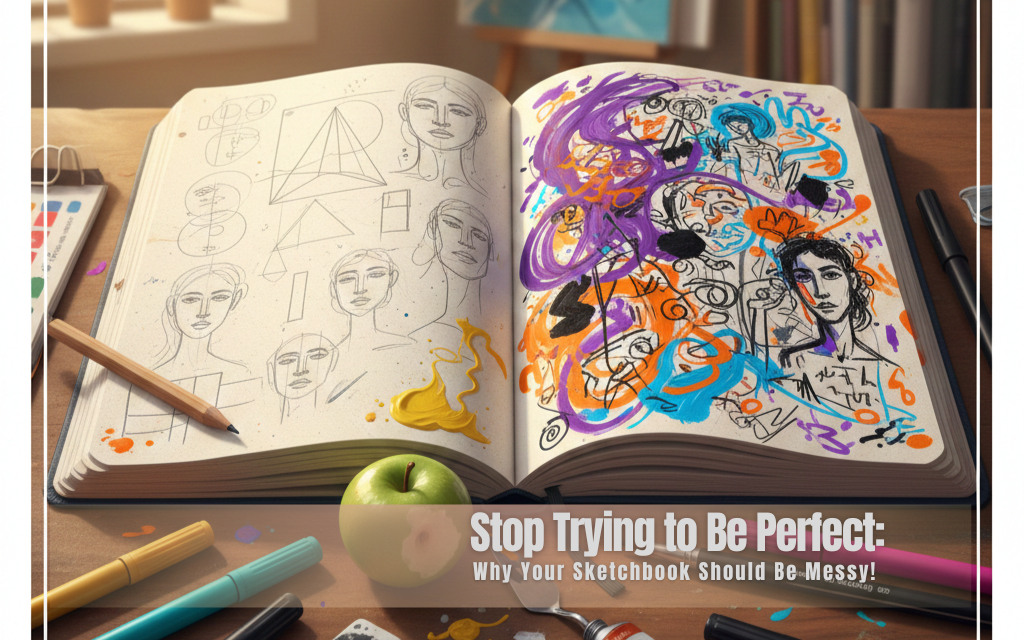
Trust me, you’re not alone. Every artist, from seasoned professionals with decades of experience to passionate beginners, has felt this pressure. We scroll through social media, seeing only flawless masterpieces, and internalize the idea that every single mark we make should be equally stunning. But here’s a secret: that perfect image you’re chasing? It’s often the result of dozens, if not hundreds, of “ugly” drawings that no one ever sees. Your sketchbook isn’t meant to be a polished gallery; it’s a rough-and-tumble laboratory, a playground for ideas, and sometimes, a war zone of mistakes. In this post, I want to show you why embracing the mess isn’t just freeing – it’s absolutely essential for your professional growth as an artist.
Perfectionism vs. Professionalism: Why Speed Trumps Polish (Sometimes)
Let’s be honest, perfectionism can feel like a badge of honor. We often think it means we care deeply about our craft. But in reality, especially in the fast-paced world of professional art, it can be your biggest bottleneck.
In a professional studio-whether you are working in animation, game design, or product illustration-time is money. An art director doesn’t need you to spend three days perfecting a single concept sketch. Instead, they need you to explore many ideas quickly. Here is why embracing the “messy” stage is actually a professional superpower:
- ➫ Rapid Idea Exploration: You can test ten different character poses or five lighting scenarios in the time it takes to meticulously polish just one.
- ➫ Avoiding the “Detailed Eye” Trap: Perfectionism forces you to commit too early. You might spend hours rendering a detailed eye, only to realize later the entire head shape is wrong. Messy sketches keep you focused on the “big picture” first.
- ➫ Lowering the Stakes: When you give yourself permission to be “ugly,” you reduce the fear of failure. This freedom allows you to step out of your comfort zone and tackle challenging subjects you’d normally avoid.
- ➫ Finding the “Bullseye”: Think of it like archery; to hit a bullseye, you usually need to fire many arrows. If you only allow yourself one “perfect” shot, you will rarely hit the mark.
Consequently, focusing on quantity over pristine quality in the early stages gives you more chances to discover truly great ideas. Moreover, this is exactly where real growth happens-in the messy, unrefined space where you are free to make mistakes and learn from them.
Using Tools to Bridge the Gap: From Photo to Sketch (and Beyond)
Sometimes, our perfectionism stems from a deep fear of getting things “wrong”-especially when it comes to tricky proportions or complex details. That is perfectly normal! However, you don’t have to struggle through it alone. There are fantastic digital tools available today that act as a safety net, allowing your brain to relax and experiment without the constant worry of accuracy.
By using these tools, you can focus on being messy and creative because the “technical” part is already handled. Here are two great ways to use technology to beat art block:
- ➫ The Grid Drawing App: If you are intimidated by a blank page, a grid drawing app is a game-changer. These tools let you overlay a grid onto any reference photo so you can map out the “bones” of your drawing on your paper. Because the proportions are already handled, you can be much messier and more expressive with your actual lines and shading.
- ➫ Photo to Sketch Conversion: Using a photo to sketch conversion tool is like having a private tutor. These apps take a complex photograph and strip it down to simple lines and values. By seeing this simplified version, you realize that even the most difficult subjects are just a collection of basic shapes. It makes it much easier to dive in and start sketching without feeling overwhelmed.
Ultimately, using these digital aids isn’t “cheating”-it’s a smart way to train your eye. As a result, you build the confidence needed to move away from the “perfect” photo and toward your own unique, hand-drawn style. Moreover, these tools save you time, which is a huge plus in any professional workflow.
The Beautiful Benefits of the “Ugly” Sketch
So, what happens when you give yourself permission to be messy? Surprisingly, a lot of beautiful things. When you’re not constantly judging every line, something magical happens: you enter a “flow state.” This is that wonderful zone where time seems to disappear, and your hand moves with effortless confidence. Your lines become more fluid, more expressive, and less “hairy” or hesitant. You’re simply drawing, not critiquing.
Moreover, every “ugly” sketch is essentially you thinking out loud on paper. It’s where you truly problem-solve. Where does the light hit this object? How does this muscle connect to that bone? What kind of texture does this material have? These are questions best answered through quick, iterative marks, not by trying to get it right the first time. Professionals iterate constantly, knowing that the first idea is rarely the best. These messy sketches are the building blocks of professional growth. Every “bad” drawing isn’t a failure; it’s a lesson learned, a muscle strengthened, and a step closer to understanding your subject matter more deeply. Furthermore, the sheer act of completing many sketches, even imperfect ones, builds muscle memory in your hand and eye, making your more refined work surprisingly easier down the line.
Actionable Advice: How to Get Messy (Starting Today!)
Alright, so how do you actually start embracing the mess? Here are a few practical tips you can try right now:
- ➫ The “Bad Pen” Trick: Grab the cheapest ballpoint pen you own, or even a Sharpie. Use something that doesn’t allow for erasing. This forces you to commit to your lines and learn to incorporate mistakes into the next stroke. It’s incredibly liberating!
- ➫ Timed Sprints: Set a timer for 30 seconds, 1 minute, or 2 minutes for each sketch. The goal isn’t perfection; it’s simply to capture the essence or gesture of your subject. It’s physically impossible to be perfect in such a short amount of time, which immediately takes the pressure off.
- ➫ The “First Page” Rule: When you buy a brand-new sketchbook, scribble on the very first page immediately. Draw a squiggly line, a random shape, or even just write “This book is for messy fun!” This little act of “ruining” the pristine page instantly releases the fear and tells your brain: “It’s okay to make mistakes here.”
- ➫ Draw What You See, Not What You Know: Instead of drawing from memory, find a complex object around you and focus on breaking it down into simple shapes and values, without worrying about accuracy. Just draw what you perceive in that moment.
A Professional Suggestion: GridSketcher
If you want to try the techniques mentioned above, I highly recommend GridSketcher. It is a fantastic tool that combines the power of a grid drawing app with a photo to sketch conversion feature. It allows you to adjust the intensity of the sketch, meaning you can see exactly as much detail as you need to get started. It’s perfect for bridging that gap between a digital reference and your physical sketchbook.
Conclusion: The Beautiful Result of Ugly Work
Your sketchbook isn’t for showing off; it’s for growing. It’s a personal journal of your artistic journey, filled with experiments, happy accidents, and yes, plenty of “ugly” sketches. These messy explorations are the honest, gritty work that ultimately fuels your professional development and leads to those moments of true brilliance. So, toss aside that fear of imperfection. Go ahead, make a glorious mess today. Your future, more confident, and undoubtedly more skilled self will thank you for it.


